




November 2007
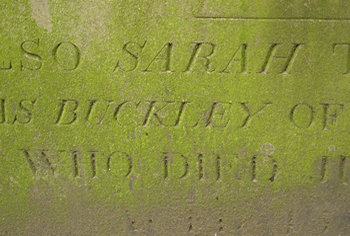
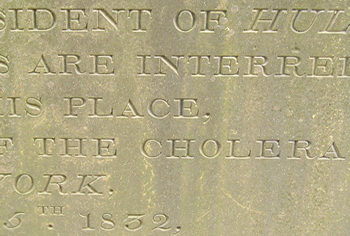
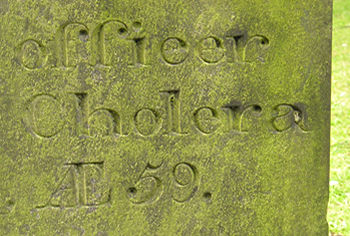
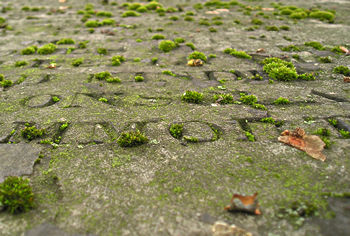
The cholera burial ground is a small grassed area close to York station. York residents like me barely give it a second thought, having passed it so many times. Visitors to the city arriving by train no doubt notice, on leaving the station, this strangely dislocated graveyard. Perhaps with that in mind, York Civic Trust have provided an information board, which tells us that the area was specially acquired for the burial of some of the 185 victims of the 1832 cholera plague, and that there are 20 surviving memorial stones. Four of the stones are shown here.
There were four cholera outbreaks in Britain in the 19th century – the 1831-32 outbreak was the first. Cholera came from India, via the trade routes, reaching Europe in 1826, and then the English ports. It reached Sunderland in 1831, spreading then to other north-east towns and cities, then south to York and to large cities such as Manchester and Liverpool, continuing to spread throughout the country through 1832.
I remember as a child being told about the burial ground, and how it had to stay undisturbed for fear that any interference with the graves would release the ancient disease (the 19th century seeming like ancient history then) back into our 20th century world.
The story of this burial place, and the implied sense of lurking danger, somehow appealed to that childish fascination with all things slightly macabre, and I remember the place seeming slightly eerie.
Now, as an older person, when I look at old memorial stones I feel sad rather than spooked. As I’ve recently been researching family history, the Victorian period no longer seems so remote.
The sandstone is crumbling, in some cases, with one stone eroding away dramatically in its lower half, but the surviving inscriptions revealed, as gravestones always do, fragments, details, of lives and relationships. This place is, as the Hutchinson & Palliser guide to York says, ‘poignant without sentimentality’.
At one time the medical establishment’s belief was that diseases like cholera were caused by bad air. We should perhaps be thankful that it was eventually recognised that the best way to combat cholera was to separate drinking water from sewage. The enlightened gentleman who promoted this theory – a British physician considered one of the founders of epidemiology – was John Snow, born in 1813, here in York.
Sources / more information
BBC website – Historic Figures: John Snow (1813 – 1858)
John Snow’s early years – from UCLA, Department of Epidemiology
A plaque in North Street commemorates the life of John Snow
York (Bartholomew City Guides) – John Hutchinson & D M Palliser (1980)
These grave’s have & should always stand as a reminder of the terrible disease & how it affected & indeed took so many lives. They should never be tampered with by anyone.
York is so full of history of which the Cholera Necropilis is but a part of it yet those who live here pass it daily with no thought to whys? and wherefores of the sad demise of its inhabitants who sleep there because of the contagion risk do so.