




June 2011
See also: Not forgotten … (December 2015)
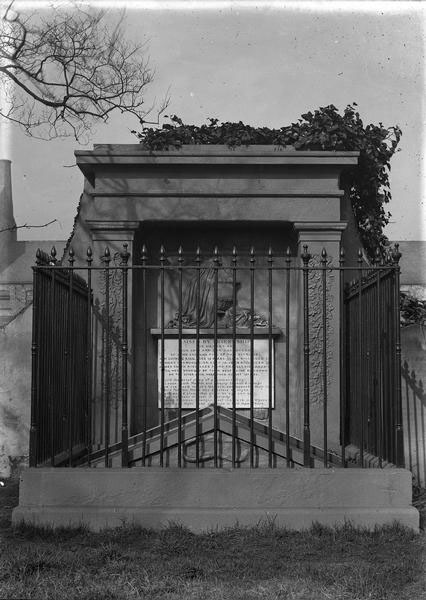
In the churchyard of St Lawrence’s, close to the tower of the old church is this once significant monument to members of the Rigg family, erected in the 1830s. It’s so substantial it has its own brick wall behind it, iron railings around it. It once had a long inscription, unreadable now.
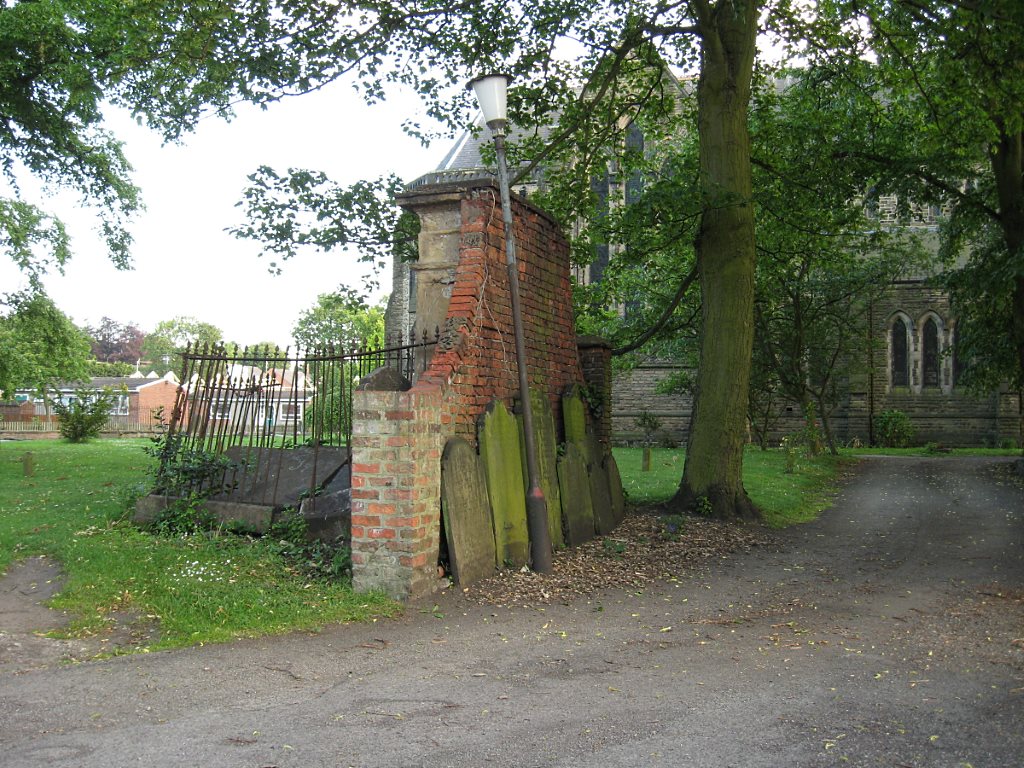
Rigg family monument, 2 June 2011
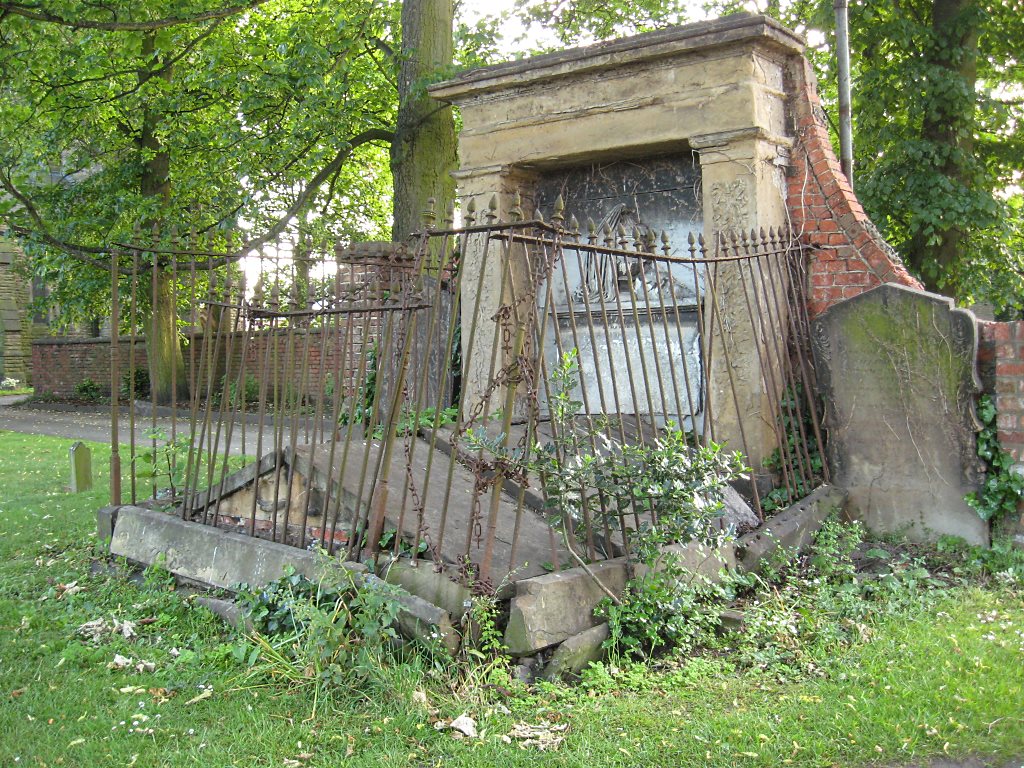
The whole thing looks to be collapsing in on itself, with even the lamp post behind leaning in.
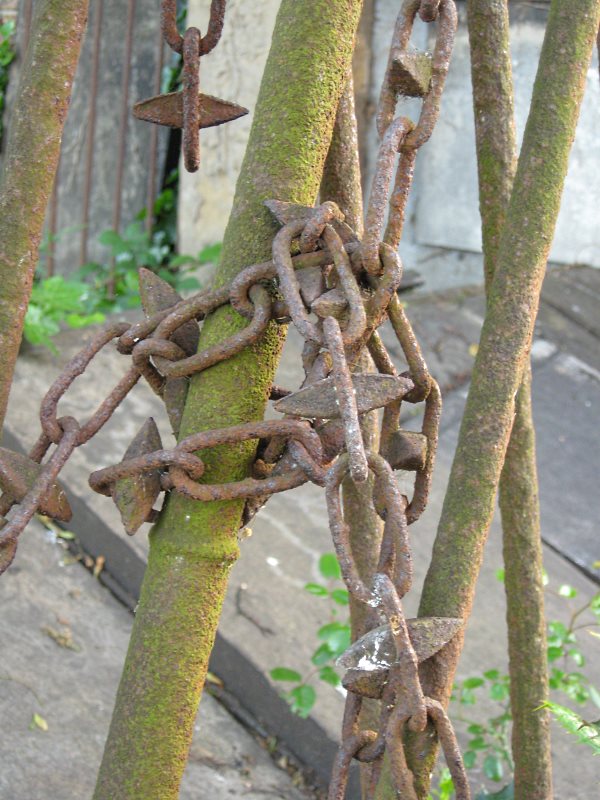
2 June 2011
Mr Rigg was a seedsman with premises on Fishergate. The sons and daughters of John and Ann Rigg went for a boating excursion on the Ouse on 19 August 1830, with friends. Their rowing boat met a keel near Acomb landing and collided with it, and they were thrown into the water. Six members of the family were drowned.
Public grief in response prompted a subscription fund, to pay for this once grand memorial, with a sculpture in marble by William Plows, and a specially commissioned verse from Sheffield poet James Montgomery.
The inscription once read:
RAISED BY FRIENDSHIP
IN MEMORY OF
FOUR SONS AND TWO DAUGHTERS
OF JOHN AND ANN RIGG, OF THIS CITY ; VIZ.
ANN GUTHRIE RIGG, AGED 19 YEARS;
ELIZA RIGG, AGED 17;
THOMAS GORWOOD RIGG, AGED 18; JOHN RIGG, AGED 16;
JAMKS SMITH RIGG, AGED 7 ; AND CHARLES RIGG, AGED 6;
WHO WERE DROWNED BY THEIR BOAT BEING RUN DOWN
ON THE RIVER OUSE, NEAR YORK, AUGUST 19, 1830.
The sculptural details were carefully chosen for their symbolism (see contemporary description below), though their significance is rather lost to us now.
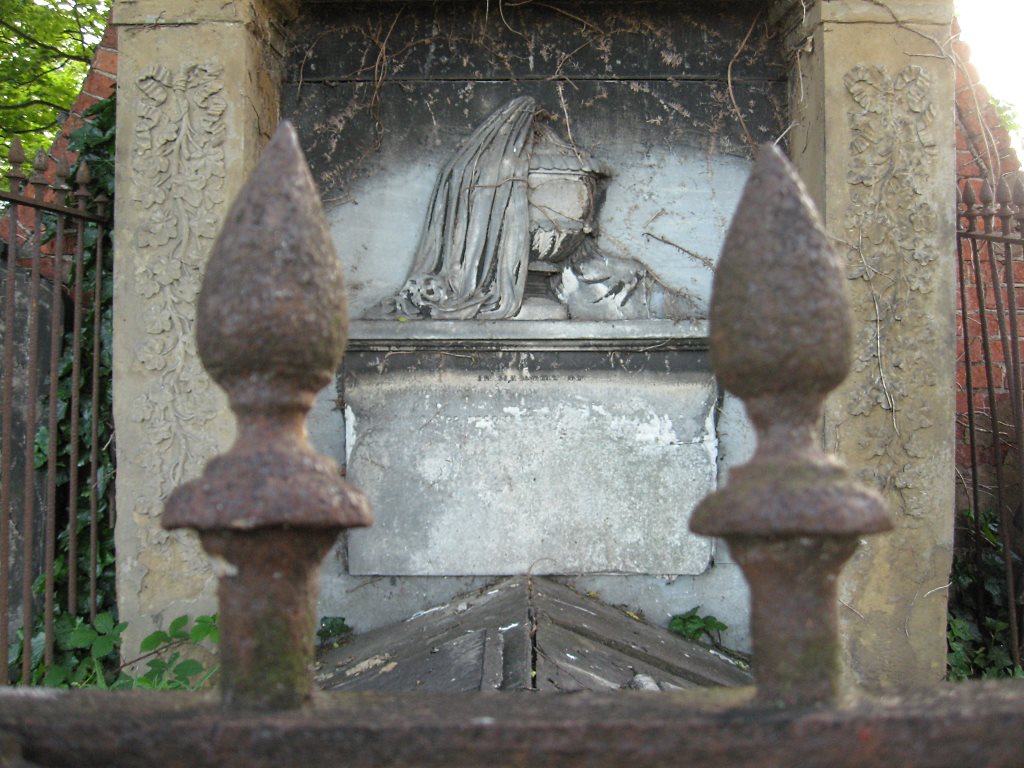
Detail, 2 June 2011
The inscription filled the flat marble tablet below the sculpted urn, and included James Montgomery’s verse:
“Mark the brief story of a Summer’s Day!
At noon, Youth, Health, and Beauty launched away;
Ere eve, Death wrecked the bark, and quenched their light;
Their Parents’ home was desolate at night:
Each passed, alone, that gulf no eye can see;
They met, next moment, in Eternity.
Friend, Kinsman, Stranger, dost thou ask me Where?
Seek God’s right hand, and hope to find them There.”
It has had some maintenance – this photo taken in October 2004 shows the lower part of the monument swamped by brambles. The pillars carved with symbolic ivy were then covered with actual ivy, which has since been removed.

October 2004
A book published in 1839 includes a full description of the symbolic details, many now weathered away:
“This affecting testimony of friendship has a very handsome appearance. The vault is covered by an entombment in form of a pediment, a squandril in front having a serpent in relief, coiled in a circle, as an emblem of eternity. Above this rises the basement of the ground-work of the monument, whereon stand two massy square stone pillars, elegantly carved in front with ivy leaves, expressive of friendship. These are surmounted by a fine Grecian cornice, designed after a monument erected over some youths at Thysillus, and which has stood there above 2000 years. Branches of palm and wreaths of laurel are introduced in the frieze. The interior work is wholly of marble, the ground of Italian dove. The tablet is of white marble, supported by water and ruffled leaves … The tablet is surmounted by a bold cornice, which supports a massive urn, partially concealed by drapery, all wrought in white marble. The height of the monument is ten feet, and it is eight and a half wide. The whole is very well executed, and both the design and the sculpture are very creditable to the talents of Mr. Plows, of this city, by whom it was erected.”
– from Lyra Eboracensis, T Hollins (1839)
How it used to look
The city archives have a photo of the monument in better days.
The Rigg family monument in St Lawrence’s churchyard, as it used to look. Photo: Explore York Libraries and Archives
More information
Different sources have some variation in Montgomery’s verse epitaph, particularly in the last line. The inscription quoted above, which seems most likely to be correct, is from Memoirs of the life and writings of James Montgomery (vol 4), by John Holland and James Everett (1855), p383
Other poets apparently suggested verse, though Montgomery’s poem was used. The Tatler included a verse offered by Charles Lamb, which apparently ‘arrived too late’ to be included as the inscription.
On this site, see also: York’s early nurserymen
The accident was reported in The Gardener’s Magazine (1830), p640.
. . . . .
Note, 9 Dec 2015
I’ve updated the original 2011 page, which had rather small photographs of the monument, with larger versions, in response to renewed interest in the monument following a story in today’s Press: Civic Trust aims to restore 180-year-old monument to six York children who drowned – as a memorial to all York’s river victims.
This page, like the many hundreds of others on this site, is by Lisa @YorkStories – and it illustrates as well as any other that I’ve been providing useful and interesting local content online for many years. If you appreciate this page and others like it, and would like to support the work that goes into creating and developing this website, please consider supporting it.
Lisa, did you know that Montgomery spent some time (IIRC, 2 years) imprisoned in York Castle for publishing an unstamped newspaper around 1799? There’s info on him in there. After he got out, he went back to editing the ‘Sheffield Iris’ up to about 1820. He could write.
Cheers Chris, I had a quick Google and found a poem by Montgomery written in York Castle, about a ‘water wagtail’ – which nicely fits with recent comments regarding the seasonal wagtail flocks in Parliament St. (Not sure what type of wagtail a water wagtail is, but water very much an issue too, of course, at present … and we like it here on York Stories when one story naturally leads into another, in this multi-layered, multi-storied place …)