




3 July 2006
Acomb: the place where dreams are made. Well, mine were. All my dreams were about escaping from the place.
I’ve had a rather negative view of Acomb for many years, probably since I left home at sixteen. It’s difficult to appreciate properly the place where you grew up. But as I was born a few streets away from Acomb Green, and used to know the place well, I’ve been meaning to return to this area since I started to take these photos of York. As it turned out, it was a surprisingly pleasant wander.
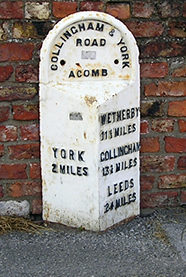
The photos on this page were taken on the evening of 3 July 2006. This one, left, shows the late 19th century cast iron milestone on York Road in Acomb.
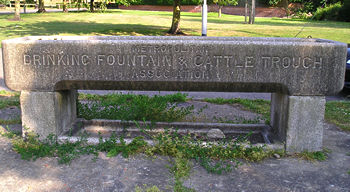
Near the green is this cattle trough, which was close to some benches which were a favourite haunt of ours in our teens. I was always rather struck by it (but only in the vague way adolescents are in anything inanimate). Even in the 1980s, though it’s oh so long ago, there seemed little need for a cattle trough in these parts.
The inscription says "Metropolitan Drinking Fountain and Cattle Trough Association", and I thought that instead of rambling on self-indulgently I should find some proper information for you, dear reader. And I quote: "The Metropolitan Drinking Fountain and Cattle Trough Association was an association set up in London by Samuel Gurney an MP and philanthropist and Edward Thomas Wakefield, a barrister in 1859 to provide free drinking water. Originally called the Metropolitan Free Drinking Fountain Association it changed its name to include cattle troughs in 1867, to also support animal welfare.” This comes from a page on the marvellous Wikipedia.
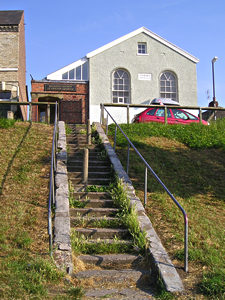
The path across Acomb Green, towards these steps (left), is so familiar. When I was small, we used to go this way to go shopping in Acomb. My mother used to talk about going "into the village". Acomb was of course once a village, hence its village green. But even by the 1970s it was a suburb, and today you can’t really tell where York ends and Acomb begins.
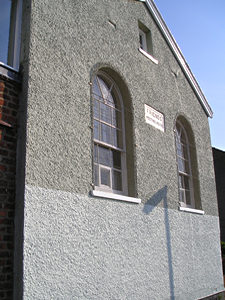
Nicely placed at this side of the green is the tiny Friends Meeting House, which I’m pleased to see is still in use and looking smarter than I remember it. Pevsner tells me it was originally built for the Primitive Methodists, in 1846, and converted to this Quaker meeting house in 1912.
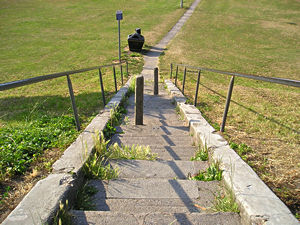
The steps by the Meeting House looking back down onto Acomb Green. These steps evoke more childhood memories than the ordinary path across the green – probably because children usually go up and down steps by jumping or skipping down them, whereas adults don’t find them so interesting.
It’s all fairly unchanged here on Acomb Green – though there are perhaps more weeds in the paving. The most obvious additions in the last few decades are the signs banning the drinking of alcohol here. And the dog dirt bins.
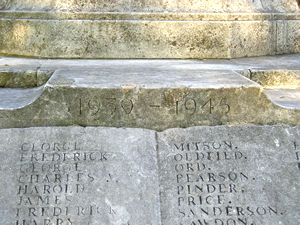
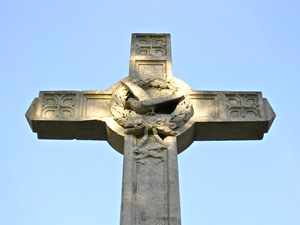
Some things change, while others stay the same, intended to be permanent reminders. Acomb’s war memorial is here, in a garden at the top end of the green, fenced off and planted with trees and shrubs. We used to sit here as teenagers, in the evenings. (Now I’d think of sitting on a war memorial as not very respectful.) And at the time I don’t remember noticing the cross above our heads, with its dove – though around this time a few of us were beginning to get politically aware, and joining CND, and some of us were wandering around with a dove of peace embroidered on the back of a smelly old afghan coat.
Checking up on the factual details, I see that the memorial was originally erected around 1920, then altered after the Second World War to include the additional names shown on the open book (photo, above left). Even more recently, it has been restored, and also given a Grade II listing (in 1997).
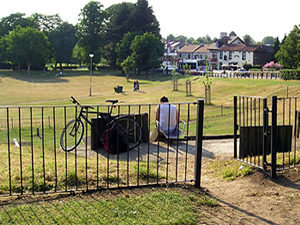
Acomb Green is really big, I realise, certainly compared to Clifton Green, which I pass more often these days. Both are triangular spaces between converging roads, but on Acomb Green people play football and there’s a children’s playground, and people sitting around admiring the view.
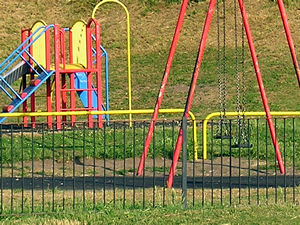
I remember this place after dark, twenty or more years ago, when, as teenagers, we used to sit on the swings and the children’s roundabout and hang about doing nothing much, until the time we had to go home. During this evening’s visit I noticed that the old traditions continue, though apparently in different locations. Numerous young people were seen (and heard) hanging about in groups sitting on walls and doing nothing in particular.
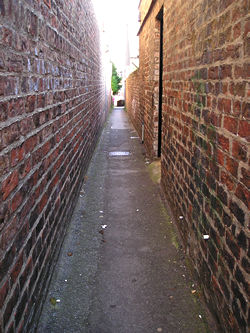
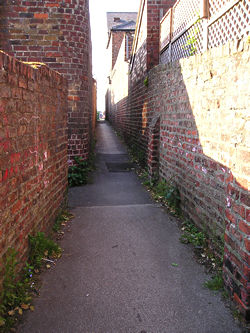
Perhaps my clearest memory of childhood walks through Acomb – this pokey narrow alleyway which leads from the road at the side of the green.
At the other end of it is Front Street, with the library, post office, chemist and newsagent. I’m wondering if the surface of this alley has been altered, as I think I remember some kind of cobbles here, rather than tarmac – but what I do remember most is the sound it made as you ran along it between these high walls. There was perhaps a pipe or sewer underneath, but certainly something made it rather echoing and the sound was rather satisfying as you stomped along. Unfortunately, as I was wearing trainers on this visit, it didn’t work the same as those Clarks shoes used to in stirring up a racket. And now I’m a thirty-something, I’m obviously far too mature and sensible to go stomping along an alleyway deliberately trying to be noisy.

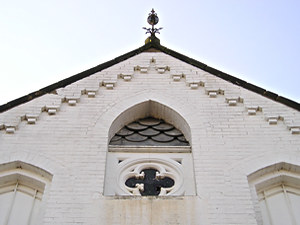
At the end of the alley, approaching Front Street, there’s a dog leg bend, next to some nice old cottages called Chapel Row.
So called because they’re at the back of this old chapel. This must be the Wesleyan Chapel of 1879 mentioned in my Pevsner guide. I can’t remember whether it was still in use as a place of worship when I lived here, but it isn’t one now. Yet it survives, as so many of these nonconformist chapels do. Perhaps their plain and high-ceilinged interiors are relatively easy to convert to other uses – this one is a carpet warehouse.
Or rather, was a carpet warehouse. More recently, the subject of planning applications to convert it into – you’ve guessed it – flats. Which means I’ve just had to take a detour to the City of York Council website to read about it. The planning application seems to involve a conversion, leaving the frontage intact (though presumably with the "Ebor Carpets" signage removed).
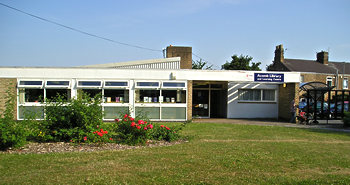
And over the road – little Acomb Library. Still looking like it did in the 1970s. Inside it will be different, of course – with computers next to the books. I could write a whole page just about this place. I remember small red plastic chairs in the children’s section, and the Beatrix Potter books that had a distinctive smell to their shiny pages.
On dark winter nights we used to go here in the car, and I remember how welcoming the library always seemed, with its bright lights. And the long wooden drawers that held the tickets for the books, in those pre-computer days. Later, how exciting it was, at fourteen, to get an adult ticket.
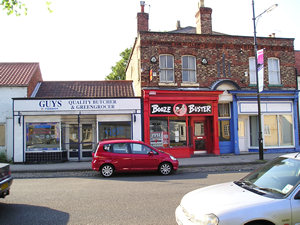
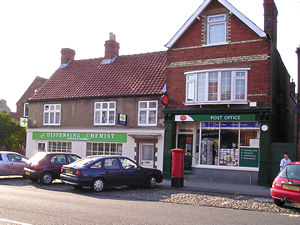
I expected to find Front Street massively changed, possibly full of estate agents and tanning studios where useful shops used to be. But it’s quite cheering to see that there are still some proper shops selling useful things. Though the butchers shop I remember (above, left) has recently closed – next to the rather bright frontage of the more recent Booze Buster, which also seems to be empty. Front Street still has a chemist and a post office, right next to each other, just like they used to be (above right). Post Offices are becoming rare in these parts, so it’s nice to have spotted one. Just up the road, the newsagent is still there too.
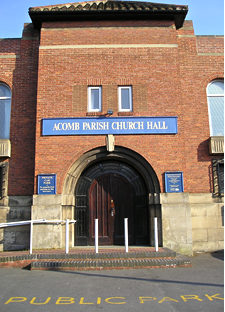
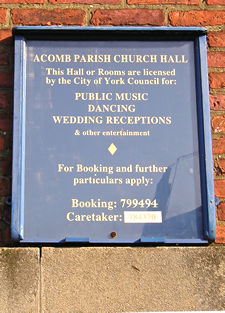
Ah, the Church Hall, which reminded me of many discos here in the 1980s. I recall spending as much time hanging around on these steps outside as we spent inside.
If I remember rightly there was a young guy at those discos who used to dress up like Gary Numan. This was easier to accomplish than dressing up like Adam Ant, and meant you were less likely to get laughed at. Though I have to confess I’ve never tested that theory. (Suddenly has embarrassing memory of being photographed in back garden wearing Adam Ant-esque outfit and determines to seek out and destroy all evidence in family photo collection.)
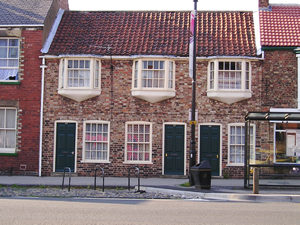
I was sitting on the steps of the Church Hall changing my camera batteries when I noticed these cottages opposite, apparently recently refurbished. Looking at the numbers, I realised that one of these cottages was where my mother lived in the late 1950s, not long after she’d come to York, and that she and my dad lived here when they were first married. It was only when I spoke to my mum while putting this page together that I discovered that my sister Kay, who died in 2001, was born in the first floor room of the cottage on the right.
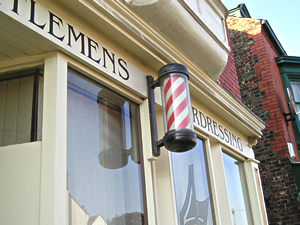
While giddily wandering around the delights of Front Street, and trying to avoid an enormous purple bus that kept trying to run me over, I noticed this rather elegant-looking gentlemen’s hairdressers, complete with traditional-style barber’s pole. I do like this smart cream paintwork and black lettering. If only all shop fronts could be so handsome. This is a Conservation Area, after all. (As I’ve just discovered, from the City of York Council website. Yes, I do spend a lot of time there, don’t I).
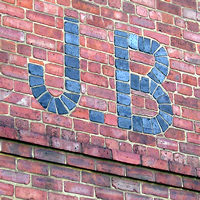
Just along, at the end of this row of buildings, this decorated brickwork I remember well, on the gable end of a large house, apparently built for someone important, with the initials JB – spelt out in blue brick.
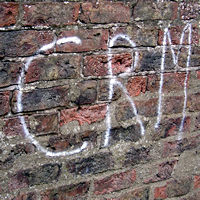
Below it, in the alleyway that runs up to the church, some graffiti. It appears to be promoting the benefits of Customer Relationship Management.
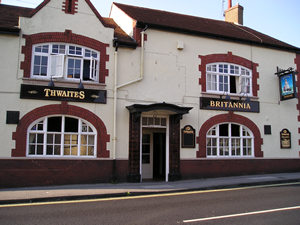
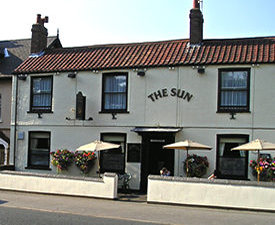
Back up the alley that leads to the church, and back on the road running alongside the green, I was pleased to see that the pubs are still here and haven’t changed their names to something stupid. The Britannia Inn – which everyone called The Brit – I remember fondly only from its smell as you walked by its door – it always smelt beery and smokey and old, like a proper pub. A kind of mixed with Sunday dinner comfortable kind of smell. I don’t recall going in here. The Sun – I’ve not noticed how it smells, though I did go in it once or twice. I only remember one visit vividly – when my sister and I went in one Christmas Day, as I wanted some cigarettes and no shops were open. The bar was busy with chaps drinking beer and we were looked at strangely – perhaps they thought we should have been at home cooking the dinner.
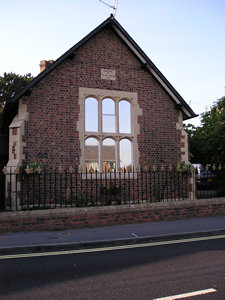
On the hill, just along from The Brit, and next to the gateway to St Stephen’s Church, is the old church school, erected in 1848. It was converted to a private dwelling in the 1980s, and I remember passing it during the time it was being converted, and feeling a bit sad about the change. I thought I remembered children here, playing in the playground, but on further reflection that doesn’t seem likely. It is a Victorian school, and I’m not quite that old. Though I’m beginning to feel like it, going up and down this hill.
Next to this building is the gate to St Stephen’s Church and churchyard, and I spent so long wandering around the churchyard that I thought it best to include the church on a separate page.
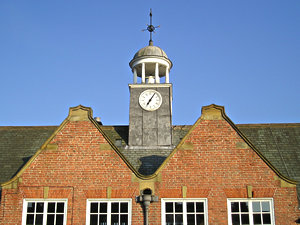
Another former school – one of the handsomest buildings in Acomb. One of the board schools built by the architect Brierley. Many of the schools he designed are still used for their original purpose a century or more after they were built. Though no longer a school, this building has, thankfully, been retained for the community, and was looking splendid in the evening sunlight. It now houses the Gateway Centre, which is, the sign says, "a place for people to connect".
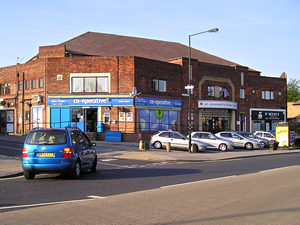
And finally on this very long page, a mention of this rather less handsome but still obviously useful building. This used to be the Regent Cinema, decades back when my mum arrived in Acomb in the 1940s. Like Clifton’s cinema, it was long ago converted to other uses. I was rather glad that one of the shops it houses is a Co-op, with a fridge full of cold drinks, as this walk took place on one of the hottest evenings of the year, and I’d been wandering about Acomb in the searing heat for hours.
Time for an expensive fruit juice, to give me the energy to carry on to West Bank Park, where I hope you might join me for a perusal of its beautiful structures and spaces.
many thanks – lovely photos. I live above the green and have been asked to produce a geogrphical quiz for the ADAM (Acomb Dance and Music) festival so people have stopping points to do quizzes and answer questions relating to buildings, parks, roads etc. Can I use some of the information in your site and possibly one or two of the photos. Quite happy getting my own but yours are taken on a summer day. Quite happy to cite you/your site in references. Many thanks, john haslam
Hi John, it was indeed a lovely evening for taking photos. Have emailed you about the photos, in case you need larger versions, those above are quite small as the page was compiled many years ago but the originals are larger & would be better for printing. Best of luck with the festival planning, Lisa
Hi John
Did you ever do that quiz? We might be able to use it for an adult learning group. Can you get in touch if you have anything available? Thank you. Fiona
All our yesterdays – great trip down memory lane.
I remember the old library with its wood panelling.
Tip Top – replaced many years later by Superdrug (no longer there and now empty).
Boots on the corner by the school dinner hall (more recently a charity shop but now empty).
The chemist on the corner of Severus Avenue (now empty).
I remember the camping /caravan showroom.
Wonderful West Bank Park only changed slightly but still as wonderful.
Just recently added a photo of the old faded Tip Top sign on http://yorkstories.co.uk/shopfronts-old-signage-york/
Me and my sister used to spend hours looking round the camping caravan shop ( Fawcetts) dreaming of having a caravan and buying all the gadgets and gismos.LOL. also remember Brooks chemist and Tip top, do you remeber Mr Darleys supermarket on the corner of Manor Drive, and Joes pet Shop, i worked there as a saturday girl !!!.
I grew up in Acomb but haven’t been back for many years. I can’t place the Church Hall at all, where is it?
Hi Jen, it’s on Front Street, just along from the library and the Marcia pub: Google Street View
I miss Acomb a lot. I don’t live there anymore, but it’s in my heart forever. You brought back lots of happy memories to me. Thank you.
Really lovely to read that Christine, thank you. I don’t know if you lived there when Tip Top was on Front Street, but its old signs have been visible again recently, included on this page: http://yorkstories.co.uk/shopfronts-old-signage-york/. Where I said I remembered it being similar to Boyes – whether that’s right or not I don’t know, but, strangely enough, apparently Boyes is going to be opening a store there in that shop unit. Maybe has already. Hopefully someone in Acomb can update.
I used to work at Frank Dees, and before that, my paper rounds were Severus Avenue, Hobgate and Moorgate. My paper round wages were 40p a week in 1971/2. When my son started nursery I took him in to Superdrug. He wanted to ride on the horse, and i didn’t have 20p change, so i said i would rush round the shop, and get him the change for the horse. I did this then went to my grans, in Dijon Avenue. I sat down and she asked where my son was. I’d only left him sat on the horse, still waiting. Because he was going to nursery, i’d forgotten that he was with me, and not at school.He did get his ride
Oh my god !!!! Lol I did that with my beautiful boxer when I was a kid bluddy hell !!!! X
Does anyone remember Joes chip van that went yo Chapelfields? My son was 5 when we lived there and every Saturday he would ride his trike to Joes to get his chips for his dinner. He never knew that i watched him from a window, so even though he felt grown up, i always made sure he was safe.
Yes I remember the chip van, ( a bit greasy but nice)it is suprising that there wasnt a chippy in Chappy! the one near the library was the nearest, quite a walk ( for nowadays anyway),I also remember the pop man when they came round, and Couplands paper shop, the co co and a tiny clothes shop in the middle.
Does anyone remember Prestos? It was a rival supermarket to Frank Dees. You could get a single record with four songs on,that had just gone out of the charts.When i worked at Frank Dees, my wages were £7.20 a week, that was full time and one evening. I could get lots of things with that. I would pay my board, buy a dress from the shop over the road from Dees, and still be able to go out with lots of money.That was only in the early 70s. By the time babies grow up now, they’ll have to walk around with wheelbarrows to carry their money when they go out to the pub ha ha
I used to go to Acomb County Primary school. The toilets were outside. I learned how to play the recorder there, and when i was 10, i learned a song from a supply teacher, called ” The Ash Grove ” I still sing it sometimes.We played “elastic” and never spoke to boys, they were like aliens to us girls. My secondary school was Lowfield, i had my first crush there and life was so simple, homework then playing out. We learned to cook and speak French, write english and hate games time. There were no computers or calculators.History was taken by Mr Nodder, a little man who was so boring that it’s a wonder we ever stayed awake.Mrs Brown had the cookery class, i hated her, and i’m sure she disliked me.They used to call the class ” domestic science” which only the girls did. Boys did woodwork.Grown up men never pushed a pram, or pushchair, it was womens jobs to do that. I still look in amazement to see a man do that.On the buses, people could smoke upstairs. How times change, not only in Acomb, but everywhere. I felt safe and comforted by the fact that i felt loved by the village itself, but, i’ve heard that it isn’t like that anymore.
What year did you go to Lowfields
I left Lowfields in 1972, and went on to work at Frank Dees supermarket. I’ve tried to find people to sort out a reunion, but no one has replied to my request on Friends Reunited.
I went to lowfields and think I may have known you my name was Annette Cluff
Hello Annette, i remember your name, but not the face. My friends were Teresa Barnet and Susan Plows, later, also Hazel Brown. Teresa used to get nits a lot, so my gran, who i lived with, shampooed my hair in nit shampoo every week, just incase.. Those carefree days were brilliant, weren’t they. I tried asking about a reunion, over the years, but there never was one, to my knowledge.I hope life turned out well for you. I now live in Doncaster, but my family tell me Acomb has changed for the worse now, that’s a pity
Become an awful place to live, which is a pity
Sorry about repeating myself. My laptop crashed, so i pressed send a few times, so i didn’t have to rewrite it.
LOL I went to Lowfield,class 1H or something H, we had Mr Nodder as my form teacher and for history, he used to slam the desk lid down when we didn’t pay attention, Mr wood for French, Miss Foster for PE, Miss Howdle…head mistress… for DS ( eeek ), Mrs brown or Mrs Patterson for sewing, ( she had eyes in the back of her head), Mr Marshal did boys PE, Miss Campbell for biology she sometimes brought her Dulux dog to school and left it sat in her little car all day, Mr weir for geography, Mr Aire was the Headmaster,we had some good times and bad times at school activities week was a high light and school discos in the gym !.Talking about smoking i had an ash tray on my bedside table in Fulford maternity hospital, i didnt smoke when i was pregnant as it made me sick but was tempted back to it when the trolley came round in hospital and actually sold cigarettes along with the mags, newspapers and sweets LOL !!!…
LOL I went to Lowfield,class 1H or something H, we had Mr Nodder as my form teacher and for history, he used to slam the desk lid down when we didn’t pay attention, Mr wood for French, Miss Foster for PE, Miss Howdle…head mistress… for DS ( eeek ), Mrs brown or Mrs Patterson for sewing, ( she had eyes in the back of her head), Mr Marshal did boys PE, Miss Campbell for biology she sometimes brought her Dulux dog to school and left it sat in her little car all day, Mr weir for geography, Mr Aire was the Headmaster,we had some good times and bad times at school activities week was a high light and school discos in the gym !.Talking about smoking i had an ash tray on my bedside table in Fulford maternity hospital, i didnt smoke when i was pregnant as it made me sick but was tempted back to it when the trolley came round in hospital and actually sold cigarettes along with the mags, newspapers and sweets LOL !!!.
I remember the biscuit shop in Acomb, it was opposite Acomb County Primary. My gran bought a big bag of broken biscuits from there, every week.
We moved to York in the early 1970’s when I was about 4yrs old, and I remember the building Christine mentioned.I’m sure it was also a discount clothes shop at some time called Thriftys as well as TipTop and Superdrug.
I’m sure you’re right, Sean, it’s changed names many times.
Yes it was called Thrifty and sold x marks and sparks clothes at a cheap price, do you remember Moors supermarket i think it changed to a furniture shop, and there was a co op over the road that no one went to oh and i just remembered Candys cabin the sweet shop and Unit 5 the toy shop and next to the school was a chinese take away that changed in to a material shop!,and Boughs that was a posh old lady clothes shop.There was a little shoe shop/cobblers down Green lane too and a chip shop called Tiger down Beaconsfield street !!!. Memories memories memories :) if we could turn back time eh.
I was born in acomb went to becky school delivered milk and papers round acknowledged at Preston,s seen lots of change,s remember fire arouse acres then went on to build the new house,s at bottom right also were the horse trough is there used to be a stream wich I think was delivered in late sixties also remember squirrel from jute road a mate I’ve not seen in years also remember why he got that Nick name lots of memories
My sister Jane corr and Carmel worked there I went to Becky 71
I remember Batchelor Hill being built, it was a field before, but the wall always seemed to have been there.
I used to have a paper round in Hobgate and Moorgate, in 1970 to 1972. My pay was 40p a week. That was a lot of money. In my first job. at Frank Dees i got £7.20 a week, full time, and one evening, until 8pm. I loved both my paper round and working at Dees in Acomb. I often think of the people i worked with, they were more like family than work mates.
I worked at Frank Dees in 1971. Used to fill shelves….mostly tinned veg as I remember. The manager wasn’t well and used to take himself off upstairs! It was a lovely place to work ‘cos of the staff…..I would have been 15. I used to be paid £6.30 a week. I’m Lynn.
Was it Mr G Roberts? I heard he was an alcoholic. He was sacked in the middle 70s. He treated me like a daughter. My asthma was bad sometimes, and he really cared about it. When we were given new overalls, he gave me the longest one he could find. He found it funny because i’m 4ft 9. He used to laugh at my red hotpants and socks. I still miss his ways.
Fond memories of acomb remember Lindsey ave estate being built new rail bridge on water end being built and dragging in the pond beneath it that was filled in bet they could not do it now
I was born in Acomb, 80 years ago. My wife and I owned our first house in Severus Street, nearly 60 years ago. Having lived out of York for nearly 50 years, we are now looking to move back to Acomb for the rest of our lives. Looking forward to catching up with everything local.
I to remember Acomb with fond memories Born in Beconsfield St, Educated at Acomb County Primary at the end of my street before moving to Lowfield’s School for the 1st year of schooling before moving to Huntington Secondary School for the 2nd year onwards(in the days when the whole of the school had 350 pupils and doesn’t refer to the intake of a single year)
Wonderful photographs bringing back so many memories. I lived in Rosedale Avenue as a little girl in 1969 and I assure you, you are not wrong in remembering children playing in the old school next to The Brit. I went there at the time, it was a nursery and infant school run by, I seem to recall, Nuns (they definitely wore black habits), but I’m confused because I thought Nuns were Catholic and St Stephen’s is Church of England. Funny the things that stick in your mind when you are 4! I remember having a key to the little gate in the wall of Rosedale Avenue, so I could take a short-cut through the graveyard to school rather than having to walk all the way round.
I grew up in Acomb, and still live here now. I have a daughter who is 5 and we intend to stay here for a long time. I love the old photos, I totally forgot what the library used to look like. Its Acomb Explore Library now and its very modern. And Bargain Booze, I forgot about that too! When you pass through the village day in day out you forget what it used to be like. These photos are a great trip down memory lane.
It’s lovely that this page has your comments added, it has been really nice to read the recent ones above, and to know it’s still of interest. The photos are quite small as it was compiled almost ten years ago. I’ll see if I can include and share the larger versions too.
So good to see Acomb on this site.
I was born in Acomb Maternity Home in Dec 1947.
Seeing Front Steet brought it all back ( now live in Cambridgeshire )
My mother best and lifelong friend Mary Double lived in the cottage next to Acomb village hall and I spent many happy hours at her home whilst she baked for most of its residents !
I then went to Westfield Primary followed by a dreadful stint at Acomb Sec , never to be forgotten .
Does any one remember the teachers there inc Miss Pycock who threw me out of games ?
Amazing that this article is still being commented on ten years after publication: it strikes me as being more about pride in where we come from rather than just a bit of nostalgia.
My family moved around quite a lot before I became a teenager: from Kingsway North to Bachelor Hill, via Pocklington and Lawrence Street. The couple of years that I lived in Acomb are some of my most memorable as I was on the verge of puberty and more interested in exploring my new environment than the opposite sex.
I’ve not read this piece until now Lisa, and only did so because of the recent comments but once again, you and various commenters have dragged up long forgotten memories. I too used to play on Acomb Green around 1970-72. I used to walk from Front Street up the narrow alley too. Wasn’t there a fish and chip shop at the Front Street end? At that time I used to work for the butcher just up the road as a delivery boy on a Saturday and I used to spend the Saturday morning delivering meat to the posher houses further up Askham Lane before turning off into Foxwood and dropping down the the steep hill to the newish estate. There was always an angry Jack Russell waiting for me at the top of the hill, near the M.O.D. houses and it would chase me down the hill until it ran out of steam. I was paid £5 for the eight hour day and remember having to deliver turkeys on Christmas morning and earning a lot of money in tips.
Deborah’s comments struck a chord with me too. My elder sister was born at the same place but my mum was living in York Union Workhouse at the time and that’s where they used to send their pregnant inmates to give birth as the Workhouse Infirmary wasn’t suitable. I also spent a couple of years at Acomb Secondary Modern Deb and yes, it was pretty grim. I don’t remember a Miss Pycock: I don’t even remember my own fascist P.E. teacher who used to get a kick out of bullying much younger boys. But for every bad teacher, there were plenty of good, caring teachers: Mr. Stroud (English) for example.
I went back to Acomb a couple of years ago for the first time in 20+ years and although some things appear to have changed, i.e. shop names, it’s still got a nice feel to it. My sisters still live there: Gale Lane and Woodlea and my dad’s ashes are still residing in St. Stephen’s churchyard: so I had a good look around. There’s still places/streets that are a bit dodgy to a stranger but that was also the case back in the 70s and it’s still the same in most areas of York today: I suppose it’s just a matter of perception.
“Amazing that this article is still being commented on ten years after publication”
– yes, it is, and I really appreciate it, thanks Mike, and everyone who has added comments. Spurred me on to do what I’d been thinking about doing earlier, just been back this evening, to do a ‘ten years on’ revisit. Quite a walk, just looking at the photos now, been looking at them for a while and still haven’t got past the alleyway by Acomb Green – keep comparing ‘then and now’. Hope to share all these (well, some of the photos, there’s about 200) soon when I can put the time into it. Thanks again to everyone who has added info and comments here,
Lisa
My mum was Mary Cluff and was 95 when she died . We have lived in Acomb all my life and still do , it surprising how much has changed. There are more charity shops and sandwich shops but it will always have the Acomb spirit.
I think you’re right Annette about the Acomb spirit.
I’ve just added some photos and notes on a new page, after a ‘revisit’ walk on Sunday, ten years on to the day from the photos above. More soon, but the part 1/intro bit is here: http://yorkstories.co.uk/acomb-revisited-2006-and-2016-walk-photos-intro/
I should have said that my maiden name was Tomlinson and we lived in Tudor Road.
My parents moved there from The Groves in York and were the first tenants in around 1937 .
Tudor Road was very smart in those days with well kept houses and gardens ( watched over by the council housing officers ! )
I started school at Westfield Primary .
Lovely headmistress Miss Langshaw , very caring surroundings and staff.Does any one recall that actress Judy Dench lived in Acomb.
Her father Dr Dench had a lovely bungalow , Indian style with an all round veranda on a small lane that came out almost facing the school ( cant recall its name at present , senior moment )but reached at one end by set of steep steps.
I well remember Acomb past .
Batchy Hill on Gale Lane .
Full of lovely cows that congregated at the front end five bar gate.
At the top of Gale Lane the farm they belonged to with its working yard where the cows were often to be seen.
It had straw barns behind and the most enormous pear tree close to the road , so easy for scrumping from !
Leading up to the church from Front Street was a lovely row of very old cottages and facing them yet another working farm who’s fields came right down to Tudor Road.
We spent hours playing in them especially the one nearest to the Acomb Hotel end .
That was the wet one with a little beck which was part of the long beck ( now culverted ) that ran all along the backs of the Tudor Road houses.
It was a magical child hood , we were completely free to enjoy the surroundings .
We also spend many happy hours on The Green.
Sledges out in the winter, boiled egg rolling at Easter ( painted at home ) and going to see the hunt gather on Boxing Day with hot toddies given to the riders but not the watchers on !
They kept pigs in an old yard behind the Marcia and we went to stroke them getting there via my Aunty Mary Doubles back garden gate that led onto the yard .
Does anyone remember the large wooden hut were sales of second hand furniture took place .
It was a small field next to Acomb School .
You could find absolute bargains there which would possibly now cost an arm and a leg to buy.
Acomb was indeed a dear country village .
Im sorry to say that when last visited about 10 years ago all that has gone , only memories remain plus thankfully on the internet a few photos.
What a fab site,so many memories, i lived there from 1970 to 2003 and still miss it now, there is nowhere quite like it for community spirit.I went to Lowfields school and lived on Marston Avenue Chapelfields, I worked at Presto then on to safeway and Jonathan James shoe shop.So many lovely memories:) :( xx
I went to Acomb last Friday for my 60th birthday. I took a lot of photos of my old house, in Dijon Avenue,West bank Park and all the various places i played. It rained, all day, so i had to give in when i got soaked. I became a child again, when i was remembering the times. Time flies too fast.
Bringing back so many memories, i lived on Woodlea Avenue as a child,about 1967, loved walking around Acomb shops, i remember a little coffee shop on the high street used to have a jute box next to a record shop in the 70s,remember Prestos, playing on Acomb Green,
lovely page really enjoyed reading
Wonderful site which took me back to the 1950s when Fred Stubbs was still selling his home grown veg etc with horse and cart. He lived opposite Dr/Judy Dench’s bungalow in Askham Grove off Askham Lane. Me and my brothers had our hair cut “short back and sides” at George Careys’ little barber shop, where, later, Frank Dees was. The Adult School – which became a commercial gym later – was on the opposite side of the side street to Boots on the corner. We kids had school dinner there during the long summer 6 weeks holiday, whilst our mothers were at work in York. Olive Brook (Brookes Chemist)supplied Boots with competition in the chemists profession. Miss Wagner taught piano lessons from her home near Brookes Chemist. The Regent Cinema doubled as a pop package tour venue spot occasionally with no less than The Everly Brothers appearing with The Dallas Boys there. Later the tours all stopped off at the Rialto in central York, Fishergate. Acomb Green played an important part in my early adolescent romantic learning curve for a year or so. We went to meet girls there and at Heptonstall’s Fish and Chip Shop at the Front Street end of the long cobbled alleyway. Fred Mitchell owned what later became Booze Buster, as a general grocery store and distinguished himself in post war austerity Acomb by chalking up your provisions bill as a debt in pencil in a little red book (which you held yourself,) until pay day! He won most custom around Acomb until the Meadow Supermarket arrived opposite the TSB at the “V” road junction near Carr Lane……………
You have lovely memories. Such a pity that things change. I worked at Frank Dees in Acomb.
The Acomb library in the pics above was the second “new” one – The first fronted the pavement and road and was demolished to make way for the newer one set further back. The little cobbled alley way joining Acomb Green to the fish and chip shop on Front Street was named Chapel Lane from which Penty’s farm field was named (Chapelfield) and later gave its name to Chapelfields Council Estate built in the erly 1950’s. Askham Lane, which extended westwards from Front Street, was actually called Skew Balk Lane as far as Kennell Lane, where The York and Ainsty Hunt kept their hounds (demolished now). Kennell Lane shows as Acomb Moor Road on early 20th century maps, and I remember it as a tractor rutted way before it was tarmaced. At the end of it, where it joined Gale Lane, on the right, was brick ponds with swans, and locals fished in it. Presumably a legacy of Acomb Brick Yard at the same site. Westfield school was named such after Farmer Penty’s Westfield Acres, on which Askham Lane was built……..
It’s lovely to see comments and memories still being added to this Acomb page, so many years after I put it online, great contributions, thank you
Lisa
The Kennell Lane referred to above is what is now Foxwood Lane, named after the private Foxwood Estate was built in the late 1960s home ownership beginnings. It was previously a very large field with mature trees dotted around and was bordered by Acomb Moor Road (later locally known as Kennell Lane later) with a draiage ditch along its side length. Children – me included – swung from thick ropes from one side to the other. “The Kennells” with the hounds were there at the time – and there was the hounds barking occasionally from them. The fields surrounding the kennells were good for mushrooming in the early mornings. Front Street earliest newsagent in my memory was Littlewoods – it may have been called Newcombe’s shortly after. And then became Hogarths newsagent for whom I had a morning and evening paper round for several years in my first three years at secondary school. William Ellis was what became The Greengrocer further along the shopping parade nearer Boots. Crows, the butchers was prominent opposite Acomb School where the clock tower was. Beans, the cobbler, was just a little down the way on Green Lane, where I had my shoes mended cheaply by “heeling and soling”. And a little further down was a betting shop (wartime habits die hard). London’s fish and chip shop was even further down Green Lane on the left. Had a reputation for tasty food, as did the “Tiger” fish shop in the Severus Street area, who had the distinction of selling Vimto soft drink. Fish and chip shop generally stuck to selling just that in those days, so itwas a revelation when Heptonstalls, opposite the Acomb library started selling pickled onions, and later the famed mushy peas, which could play havoc with a night’s sleep if eaten late in the evening. Dr Woodhead had his extensive house and gardens where Safeway, or some other supermarket chain is now. It was demolished to make way. My far=ther worked weekends for him as odd job man. And Mr Turner had his Central Garage, a little way down on the right of Green Lane also demolished for the same reason. He sold me my first car, a Morris Mini for £265.Candys, the sweet shop referred to earlier by a contributant, started out as Spencers sweet shop. Rawlings was a newsagent on the corner of Carr Lane and opposite it was the first storey Coop Hall which catered for the teenage “lemon popsicle and strawberry milkshakes” youth starting out on their first tentative, romantic yearnings by attending Saturday and Tuesday night dances. There was also a lady above the old Walkers Garage building (with its sole petrol pump and later became the 3As motor accessory shop owned by the aforesaid Mr Turner of Central Garage), who had a dancing school – its name escapes me. Next door was Boughs – the ladies shop selling shoes and handbags etc. Acomb Court jewellers was around the corner along with the Thrift Store, and there was even another fish and chip shop at some time one or two doors away from the jewellers……..
Well written Christopher ,Acomb’s history coming alive,similar to long gone Layerthorpe! I believe Foxwood Lane had already been built,when I and family,moved away in 1965,as I remember Sunday walks with pram, the full length of Foxwood lane,and back to Cormnlands Rd where I lived,in the early 60’s,while they were being built.Great back ground information on the Front Street shops,which I remember shopping at when visiting relatives in Beaconsfield Street.Well done!
The dance school was Patricia Veale’s and it’s still there – in the Regent Building though not above 3As. I remember Rawlings, I used the love going in there as a child because of the turret. My gran lived on Grange Lane and we used to walk into the village most days to do some shopping. There was a greengrocer’s called Mrs Horner’s which was not far past the post office, I think it might be a barber’s now. I seem to remember Herbert Todd’s was more central, maybe where the Halifax is now. There was also a bakers with fancy maroon drapes but I can’t remember its name.
I’ve just spent a wonderful 40mins reliving happy memories of Acomb, I’ve loved reading everyone else’s recollections too. I was born in a council house in Westfield Place and attended Westfield Infants and Primary school before moving on to Lowfield Secondary. My friend used to live at Ainsty kennels her name was Valerie Carruthers, she moved to Escrick when the kennels were knocked down and we lost touch. I remember being taken to Beans for our new school shoes and getting plastic sandals for the summer holidays. I would be sent to the Naafi shop on Askham Lane by my mum for bread and milk. I also remember being sent to the Post Office on Front Street to get a new dog licence and collect the family allowance. How I loved too going to the library, many happy hours were spent there choosing books, I still make the most of my local library though I now live in Clarkston, Glasgow. When I’m back in York I occasionally take a trip to see the house where I was born and drive through Acomb. My childhood years were very happy and I have nothing but great memories of Acomb. I’m moving back to England next year and will be living in East Yorkshire, a trip to Acomb will definitely be on my to do list.
Denise !!(Charley) wasn,t it your nickname ?
How lovely to see your comment on York stories,yes we did have an innocent childhood in those days.
I left Acomb in 2006 and have not been back but do keep in touch with some friends.I still miss it sometimes it was a lovely place to live.
Coincidental that you mentioned Layerthorpe Stephen. I was roaming around there about 8 years ago when revisiting a friend at what is now Rowntree Wharf residential apartments. This was previously a century ago Leetham’s Flour Mill where many of Hungate’s (as was) residents were employed. Some of my ancestors lived there. The Armstrong Massey garage seems to have disappeared, Ossie’s old scrap yard had disappeared – it always seemed so incongruous so near the centre Parliament Street area of York – but I didn’t care, some useful parts and cheap too, were found there! The car auction centre seemed to have disappeared, and Adams Hydraulic Works by the river gone. No surprise there! Further down the road, the Subaru dealership was still there – this was Zygmunt Curry’s petrol station and he dealt in East European cars such as the Wartburg Knight and Moskvich. Navigation Road was all built up with a Morrison’s supermarket and much more, whilst it appeared that the the area around the incinerator chimney had been redeveloped……….
Thanks Christopher I had forgotten about Zygmunt Curry’s gas station there was a mechanic who work for him who was building his own car. Ossie’s scrap yard a good place to get bits and pieces. Layerthorpe has just about gone I believe the the old Frog Hall pub building is all remains of Layerthorpe.
Back to Acomb, and the picture of Acomb Parish Church Hall made a few memories resurface. In the 1960s with the popularity of rock and roll and The Beatles and The Shadows, a lot of local pop/beat groups were formed, and the Church Hall played host to their dances on Saturday nights. Being amateur, church halls were ideal. Adrian Kaye and The Corvettes along with Steve Cassidy and The Escorts were some of the regular features I remember well. Acomb village was suddenly becoming “hip”! Other venues for the same entertainment were Our Lady’s Catholic School Hall on Sunday evenings, St James The Deacon Church Hall, and the Mormon Church further down Acomb Road. Later on Cuckstons Chemists was a new arrival next to the Post Office on Front Street…….
Stumbled upon this site while doing some family history research on my paternal grandfather who lived in Acomb prior to emigrating to South Australia as a “Barwell Boy” farm apprentice in 1923 at the age of 16. He left his parents and two brothers in Acomb. A few years later his middle brother followed him to Australia however his parents and younger brother remained there until their deaths in 1926, 1946 and 1990. I believe his father was a grocer and the family resided in Acomb Court. Interestingly I have uncovered a record of a article written by Ken Hogg ( believe this to be my great uncle) titled “Memories of Acomb Court” which is held at the York archives. I am excited because I am coming to visit Acomb and nearby Boston Spa (Pa’s birthplace) in September. Pa died in 1966 and never spoke about his life before Australia very much. I will continue to watch the posts on this page with interest!
i live in gale cottage 123 front street wonder if anyone knows anything about this house,its the pair of mid victorian houses ,look like station cottages,next to the gale farm surgery cant seem to find anything about the,used to be the police house i believe in the 1920s ,and was a tied cottage belonging to campbell and penty corn and seed merchants
I was born in acomb nursing home April 1948. We lived in kingsway west in the prefabs I went to school in the church school opposite side of the road to acomb green my teacher was called mrs Mathews our head teacher was mr fawcet . We had a small play ground in the front of the school and when there was a funeral in the church next door we had to stand still while the people went into the church. Our school games were on acomb green in our classroom we had a large inglenook fireplace the fire was lit in the winter.i stayed there till I was seven we moved to a new estate called chapel fields and we lived at 3 Brahman rd it was one of. The first houses built years later it was a very large estate. We went to Westfield school. Later I went to beckfield lane school until I was 15.we had lots. Of lovely friends threesome still friends now .
Ps to the above the cinema was called the regent now st.leonards hospice.shop.down kingsway west we had a tin shop I think it was mr Dooley that ran it if my memory serves me well.years later I moved to 87 kings way west when we got married not a prefab though ..Ann
Great site, a nostalgic journey through my early life. I was born in 1953 in Acomb Nursing Home. My first address was a Prefab in Kingsway West but don’t remember the number. We moved to Chapelfields (1 Barkstone Avenue) when I was 2 and we were one of the first families on the estate. I remember the rest of the estate being built. My parents were Les and Daphne and there were 4 children, Ian the oldest, Pauline next down in age then me and lastly Dennis. I remember the first car on the estate. It belonged to the Wheatly family next door and its registration plate was ODN 40, black with running boards and jump-out indicators. Amazing that I can remember that, I can’t remember yesterday sometimes. Some of the stories and earlier contributors I do remember well. My first school was Westfield Infants then on to Primary then Acomb Secondary. I loved my childhood. Me and a few mates could be in the countryside in ten minutes, a walk down Grange Lane to the pond then onto the Airfield at Rufforth to dig out crumbled bullets from the sand on the aircraft gun test range. Pete Widdowson and I walked miles across farmland oblivious to the adult world into which we would be thrust later in life. Acomb Green was my main stomping ground. The friends from school (who would stay in touch right up to the present day) used to congregate most nights near the memorial. Al Wilkins, Steve Snaize, Steve Bowman, Tony (Moz) Morrallee and I all started up the growing up route together. We all live in different places now but those early ties keep us together at intervals for re-unions. We try to get aging bodies to re-enact our Soul Music dancing at the Bop (New Earswick ) then later the Heartbeat. Not a pleasant site! I’ve got lots of memories but before I bore you to death I will see if this triggers any responses.
I was in the same class as Steven Bowman and my old boyfriend was Malcolm Snaize. I still have contact with Malcolm, he’s in New Zealand. We chat twice a year. I’m in Doncaster now, but my heart is in Acomb. You have a brilliant memory. From Christine Clayton from Dijon Avenue.
Thanks Christine. Al Wilkins, Steve Bowman Steve Snaize and Mozz Morrallee were all in the top set, I joined them from the middle set to do GCSEs. The Snaize family lived on the corner of Dijon and Green lane. The porch on the side was our “den”. The house was very large, it had to be for all the Kids, and it always smelled beautifully of curry, which probably led my to my addiction to the stuff today. Malcolm was a good kid, the whole family were fantastic. I think Susan still lives in Acomb, she used to do Bridal Dresses, (Droopy and Brown then later by herself) very talented. Barbara lives in West Yorkshire somewhere. Steve’s daughter Emily also lives in NZ and his son is an accomplished musician. Steve married into the amazing Corr family from Carr Lane. Angela contributed earlier in the thread. Jane and Steve live in Scotland now.
Appologies to Derek (Dek) Beavis, I missed him from my list of best mates probably due to senility, a hangover or a mixture of the two. Dek lived on Cornlands Road near Steve Bowman.
I can remember some of the teachers at Acomb Secondary. Headmaster Fred Purnell. Mr. Stroud, Jock Ellis (English), Mr Bashford (metalwork) Wally Warnford (Woodwork) Stan Stainforth (PE) later became Headmaster, Mrs Walker (secretary, had a daughter Sally who went on to marry Mozz Morrallee) Mrs Darley (art and History on whom I had a crush, as did most of the boys after one of them allegedly saw her bra in a storeroom) Chinny Coulthard (Science) Mr. Marshall (Science) and Mr. Walker (Geography).
The only Teachers I remember from Westfield were Mr Trelaw, Mrs Makepiece and Mr Cook.
Mr. Cook used to run a model railway club at the back of some buildings on the corner of The Green near Acomb Sports Field.
I remember having get some pram wheels to buy coal from a coal merchant on Front Street opposite what is now Morrison’s. There is a cut-through to Acomb Road there now.
I remember having to wear jeans from Tip Top further down Front Street. Oh the shame!
I went to Acomb Primary, then Lowffields. My bedroom window looked out to the Snaizes back garden. Me and Malcolm used to wave to each morning while he was getting into his dad’s car, to go to school. Do you remember Steven Bowmans sister getting cut on her face by another lass? I remember hearing about it when it happened. Do you remember Gary Lewis and his sister Jane Bristow or Stacy Ryan? Do you remember the Fawcetts in the Regent area of Acomb? Do you remember Wayne Burton and Trevor Shields? I knew them all. How about John Donohue? I would love to see how life has treated them. I hope things turned out well for them all. Acomb is so big now. I remember the broken biscuit shop opposite my junior school. I worked at Frank Dees supermarket in 1972. I loved and miss all of my old workmates. My best friends were Sharon Bonner, Teresa Barnet and Susan Plowes. I hope my memories will make you smile.
I remember a girl being cut on the face when I was at Lowfield. I can’t remember the names of those involved, but I think it happened in the girls cloakroom. The perpetrator was expelled and sent to Cornlands Rd school. I was friendly with Stacey Ryan, she lived near Lowfield School. I left Lowfield in 1974.
Elaine, the girl was Stephen Bowmans sister. I remember it happening. Stacey Ryan lived near me, we hung around together, for a while. When the bungalows were being built on her land, we went looking for old glass bottles. There were lots to be found. I lived with Mrs Knott at number 73.
Thanks for your reply Christine. At one time Stacey was singing in a local band.
Eric, Did Headmaster Fred Purnell did he used to be a teacher at Park grove School and died at the age of 101.
Trev, I only knew Fred Punell during my stay at Acomb Secondary. He always looked old to us, great big bushy long eyebrows, small guy but vicious with the cane and used he to spit when he bored us stiff with stories of the pashwa af Poona.
Christine, I know Steve Bowman had 2 sisters, the older one was Janet I think. He had a younger brother Dave. Sorry I don’t know the others you mention. I think you a few years younger than me, I was born in 1953. Different age groups meant a lot more than they do now!
I know what you mean. I was born in 1956. Boys didn’t really talk to girls then.
Same guy he was just a teacher when he was at Park Grove School.He had a daughter that lived in North Bay Canada.
Thanks Eric.
Lots in latest input that brings back memories.
Born in Dec 1947 Acomb Maternity Hospital
Attended Westfield School from 1953 .
Loved the headmistress Dorothy Langshaw and the first years teacher Miss Vizack .
Does anyone else remember them.
Miss Vizacks mother ( who looked to us as ancient !)
used to pop in to see her and her class bringing huge bags of sugar sweeties to share out.
Acomb Secondary Modern followed and was a huge shock.
I hated every minute I was there.
The headmaster was indeed Fred Purnell who soon made his daughter Mary Head Girl.
He certainly caned the boys on a regular basis and seemed to thoroughly enjoy doing so.
He always looked ancient and indeed had huge bushy eyebrows
I see on the internet that he died around 2000
I well recall my mother going up to school to complain when he started to walk thorough the girls showers after we had been out doing sports lessons !
He was an odious little man .
Does any one also recall Deputy Head Miss Walker a dragon who I again loathed and who with Miss Pycock sports mistress chucked me out of their lessons ( I went on to be a district councillor so all the rows possibly helped me in local politics !)
At the opposite end of the teaching spectrum was Eric Walkington , Geography master and all round great chap and Mrs Darlington who instilled in me a life long love of history.
Regarding Layerthorpe does anyone re all the hairdressers and barbers down there , the name escapes me but my dad used to ” lather up ” there as a young man when he was out of work as a brickie .
They lived at that time in The Groves but had previously lived in Hungate possibly around the same time as Christophers family.
My mother loved recalling the old Hungate area .
Her fathers family all lived there as did my fathers lot .
Bates, Tomlinson and Godsons .
Her father used to go to see his stepfather Leonard Godson every Sunday morning taking along his own growing family including my mother Doris Shortle.
Grandad Godson lived on the Haymarket which was still in use and could recall exactly what living conditions where there.
Poor indeed but well fed as there was only Grandad Godson and one son .
Leonard Godson worked in the fruit warehouses near the Little Market behind the Shambles area so always in employment with steady income.
My mother had noted that there was always a large piece of meat roasting on a open spit arrangement over the fire .
They were green with envy as they were a family of 7 children and only one income !
Fred Purnell had or did have daughter living in Canada could this Mary be the one?.
Hairdressers in Layerthorpe one was Eric Greenwood near the Frog Hall and the other one near Downhill Street we knew him as ‘Jock’what his last name was I do not know.
Deborah, The second barber ‘Jock’ his last name was Ferris.
Many thanks Trev , it was indeed Eric Greenwood .
I think as well as cutting my dads hair he also did mothers ( she had lovely thick straight hair and liked an Eton Crop )
Do you recall the gas works close by ?
Yes I remember the gasworks the tall gasometer in camouflage color and the night the German planes machined gunned it, all that is gone now I believe new hotel and new roads are now in place.
I was reading some really interesting comments on here. Although I was from a farming family way out of Acomb, I was born in the Acomb maternity hospital. I now live in Acomb and worked basically with children with special needs once I’d qualified as a nurse at Yorks numerous hospitals, Saint Marys , County, City and Fulford. i was wondering if anyone had any information on Batchalor hill. I walk with my dog on there sometimes a friend who has lived most of his life in Acomb was asking me, so I’m enquiring for him, he remembers the school being where the new post office was, also the older childrens school being where the clock tower is(now where the church/cafe on the corner stands). His family came to York area as evacuees from London and never left.
should have said “is” not” new post office was”
I remember Bachelor Hill being farmland. I was chased by a horse and bull, at separate times. The wall has always been there for as long as I can remember. I’m 61 now. I was riding my bike on the wall, and fell off, I cried all the way home to Dijon Avenue,leaving my bike behind. When Bachelor Hill was just built, the spare land, at the back, once a year, had a fayre, including a zip wire. I think it was for the scouts, or similar.
Regarding Bachelor Hill (or Bachy hill as we called it) me and all my mates played there often. To my shame we used to throw stones at the bullocks on there and make them chase us. I still have dreams about being chased by them but I probably deserved it. I believe the field was owned by the Penty family. They owned the farm on the corner of Askham Land and Green Lane. I was told that it was a Roman burial site and stone coffins were found on the hill where the conifers stood. I don’t know if those conifers are still there? Penty’s farm had a field fronting Askham Lane with the best conker tree in the world in it. We would throw anything we could find up to get the spikey fruit for conkering. Until we were chased off by the farmer!
Thank you for making me smile because of your comment. Life was so different then.
I have enjoyed reading the comments, used to live in Dijon Ave,Mrs Knott knew every one and everything that went on,also went to Acomb county primary and then Lowfields, the names of the teachers so familiar.
Mrs Knott was not the nice person she portrayed to be, she died in a nursing home and non of her family visited. I lived with her until I was 16. In those days, whatever happened in a person’s house stayed there and no one interfered. I still don’t regret leaving. She’s buried in Fulford, with my grandad and they don’t have a headstone. I’m the only visitor. I miss Acomb, but not my childhood. Oh, and I’m Chris Clayton.
Oh I remember this all well and I think some of the corespondents. Lived in Woodlea Ave(41). Remember… Yes I’m 74; Fawcets green grocery stall pulled by a horse (I have photo!), the gas lighting, The ‘other’ chapel(Sanctury)in Front street next to the school 9 th erorgan was taken out to go into the new chapel near boroughbrige road). Next to that the kindergaten (Went there, place made of wood). just remember the ‘Green bus company’ Turning around a single decker into the road at the back of the green opposite the vicarage gates. The ponds (kings fish ponds from the blue house)in Woodlea Ave. The quaint bridge over the river which is a culvet now to the side of Danebury Drive. Air raid shelters on the green and also in Briar Avenue, where grandma lived. I was in the first year at Car School it was brand new and had teathing problems, to hell with HSE because behind the bike sheds of the junior dept was the river unfenced!. Remember some school fellow internees, Brian Eliss, a lass called Curry…. In Rosdale Ave was a wooden shop, where there is gap to walk though to the woods. It sold newspapers and sweets (if you had the rations) The number 1 bus when it commenced reversed around into the end (revered!) Beckfield lane, which had a small section unmettaled). There was marrow gauge railway to build the car estate, saw the stuff a the end of Danbury drive and again at the end of Woodlea Ave. Woodlea bank had a very high Privat hedge up the new houses side which was buldozed by an early machine. The row of shops on the parade (never completed and can still be seen like that today, but the public lavs have gone) Miss Greg’s sweet shop (hell she was a grumpy indiviuall). Further along in the sables of the original house which had stood where the saving bank was, was located a green grocers. Hudson’s Radio & Tv shop, Thrift (not thrifty) stores where built where Hudsons Antique shop was (another part of the same family). Remember the 2 houses stuck out into Front street? and the trees down the side of the road? one house about where the new chapel is and the other at the corner of Gale Lane,near Penties farm which use ot tkae catlle up askham lane. There where 2 blacksmiths when I was young, one in the row (end unit) by the new chapel and the other up a yard? (grass and a mess) near the then post office. The last wall of the foresters hall was still decernable. Ridgways was unmade and served only a few houses at the Beckfield lane end. Then there was Elliots environmental mess up Wetherby Raod. Miss Brookes Chemist (her mother taught piano, she was of eastern European origin, so do not drap yourr finghers). The Regent I did not frequent as Mother was against it (as she was against most things), but the projectionist repaired the volume level potentiometer weekly with a 2B pencil!. I went into the scala projection room but not the Regent. Below the original boundary the tram standards where still in situ as was the tram shelter at the Regent, covered in Convolverous. Another Fawcet ran a Coach business from a building opposite the Regent (the house at end caught fire one Saturday morning) and above this was Parvin Radio and tv. The coaching also sold pertol across the pavement as did Colingbourne who aslo sold radios and tv (KB francise). ‘have a photographic mind and can see all this as if was yesterday. I could keep on but this space must be limited!
What a lovely tale of memories David thank you.
Great reading I enjoyed it. You should have been born in Layerthorpe.
I like some others discovered this page whilst looking for history on Acomb,
I was born in a house in Milner Street in 1935 as were my two brothers, Roy in 1933 and David in 1937, David sadly died in 1944 aged just 7 and is buried in St Stephens Church Yard. We all attended Acomb Primary school as did my Mother and her 10 siblings, Mums maiden name was Cowie, her Mother’s name was Lily Cowie and she was I was told a staunch Labour supporter and the Labour meeting rooms which I believe were in Beaconsfield Street was eventually named “The Lily Cowie Rooms”.
When war started in1939/40 we moved as a family to live with my granny in 3 Danebury House as my Father was in the Army and we stayed there until September 1946 when we joined my Father in Germany and led a nommands life from then on and and I continued as I too married a soldier!
My memories of life in Acomb are very happy ones with few exciting moments as children, the unexpolded bomb in a field in Front Street and dashing out at lunch time to see it – couldn’t get far as the police and army personally quickly showed us away and told to get back to school!
My cousins who lived in Beaconsfield (Norman, Peter and Pat Murray) also dashed up to my granny’s house again at lunchtime as we had heard it was on fire! not too serious just burnt the staircase down after an electrical fault in the cupboard under the stairs which we referred to as the goblin cupboard as the vacuum was kept in there.
I remember the air raid shelters under the top end of the green which was opposite to granny’s house, we went down there once during an air raid but never again my granny refused to go again. We had to pass Sun public house and the Church School playground and down the hill as I thought it was but on a visit years later it was a slope we used to look up to the Maternity home and sometimes saw nurses holding babies.
As I am approaching my 83rd birthday I wonder if any one of my time in Acomb is still alive!
Hi Margaret,lovely to read your acomb story,and to know you are one of our “YORK survivors” as is my wife Lilian(nee Barker).She is of your generation,a twin born into a bungalow in Ouseburn Avenue,(in 1931),and moved to 56 Milner street to see out WW2 with her twin Sylvia and Mum,with her Dad away at the war.Perhaps you may remember knowing of these lasses in your time in Milner St,she remembers it all with great fondness.A little older than you but still going strong,altho’very averse to computer “Magic”!
Hello Margaret, I was a close friend of Davids, and came to your Grannys house a few times, I lived on Front St, Used to hate it when you came to take David Home. i remember the fire and Davids death , .
we were due to go into the junior school in the September, he died during the holidays as I remember, I am Alan Powell
Thank you for sharing your lovely memories.
Thanks Margaret good reading I wish more people would write comments about the areas they used to live in.
Odd I just came across this post after just having a walk around some of my old haunts in Acomb, the old kennels atop o’ Foxwood lane, then over the road to Askham lane, across the fields at the back of Askham lane, onto Grange lane then down to the a1237! back in to Chappy and a look around where I once live Barkston close. I feel sorry for Acomb it seems the poor relative of York but I will always say this, Acomb has the best people ever, that is a fact. Will have to go more into the shopping area of Acomb, admit I hated it as a kid being dragged there on a Sat to help with shopping. Love the article you wrote, look forward to seeing more esp about Acomb. As a kid I hung out alot in the alley between the chippy and flats that was the carpet shop, happy days seems so long ago now!
I’m kinda blown away by how much you had to write about Acomb. I came across your article whilst browsing for York photos on the Internet; little did think that Acomb would be so well featured.
I too was once an Acomb lad who was born into the old maternity home. I started my education as a four-year old at the Acomb Council School in the early nineteen-forties.
As for the Regent Cinema, I was a regular of most Saturday afternoons. In fact, I recall seeing my first, ever, film there: “Snow White and The Seven
Dwarfs.”
I’m very much the old man now, and could easily ramble on, but I’ll spare your eyes and patience by leaving it there.
Congratulations on your excellent work,
Tony.
In later years I delivered morning newspapers along Arkham Lane for a high street newsagent — Smallwoods, or perhaps Littlewoods, memory fades.
Je suis né à York et vivais à Acomb. Ma mémoire remonte plus loin que vous ne le dites, La construction de Danebury Drive et le chemin de fer à voie étroite utilisé, Later Chesterfields, en fait, juste au bout du Green Bus pour rejoindre le green du village, il a fait face au presbytère où se trouve la maison Quaker. Cela a été placé par le numéro 1 jusqu’à la voie Beckfield (fin). J’étais en 1ère année à l’école Carr, sous Miss Manor, je me souviens des abris anti-raid sur le green et à l’arrière au sommet. Le régent était l’un des deux cinémas prévu, l’autre devait se trouver à l’autre bout de Car Lane (Ainsty). L’abri de tramway (mais pas les tams) du Régent. Tous ont été plutôt bâclés maintenant.
sorry I posted that is French, where I am now (at times) In reply to thee earlier posting, I was born on the Mount at “Miss Dockin’s” Nursing home, we lived for short time in Briar Avenue and then Woodlea Ave (41). I staggered through the 2 Carr schools, even tolerating Mr Cross, then left for Wetherby. Here is the latest in English (Thanks Mr Google)
I was born in York and lived in Acomb. My memory goes back further then you tell, The construction of Danebury drive and the narrow gauge railway used, Later Chesterfields, in deed just the end of the Green Bus to the village green, it turned opposite the vicarage where the Quaker house is. This was placed by the ‘Number 1′ to Beckfield lane (Wetherby road end, no number 8).I was in year 1 at the Carr School, under Miss Manor I remember the air raid shelters on the green and in the backside at the ‘tall ‘end. The Regent was 1of 2 cinemas planned the other was to have been at the other end of Car Lane (Ainsty). The tram shelter (but not the tams) at the Regent. All been rather botched up now.
Coming back to this article wondering if anyone remembers Grange Farm down Grange Lane , Acomb.
I used to go there to see my friend Pat Bean who’s family owned the farm.
Georgian type building set back from the lane.
The house had a wonderful old kitchen and I think two staircases .
We lived in a two up two down council property so I was in awe of this to my eye enormous rambling place.
IF my memory is correct they bred pigs in a barn just behind the lovely old farm house itself.
I biked there from Tudor Road down a narrow country road that on google maps seems now to come to a stop before the by pass .In the past you could I think get all the way through to Rufforth .
Pat went to Westfield School were we met then onto Acomb Secondary , but, I think her parents then sent her somewhere privately.
Chappel fields was just very nice hillside. I have photograph of the end house in Askham lane with a field next to it. My father who wealed a paint brush (artist type) painted a picture of farm building at Chapel fields. You could walk up grange lane and come out by the last house in Wetherby Road.
Fox wood land did indeed have the kennels ( have photo of these in run down state). This lane did not go all the way metaled into Gale lane, but had a mud section. There was petrol station (BP) at the end of Gale lane and of course the brick works. The kilns where home to vagrant my father had words to him. I was told not repeat them to Mother. York itself was most interesting, The Scala Cinema was known to me, it was the last place on DC mains penultimate Leak & Thorpe) supply. Very old equipment. Had an orchestra pit in case the talkies did not catch on. The Tower was the only one with stereo sound. When it closed I made visit and got the slides (50 x 50 size) from the demolition guys (York relay!, Persil washes whiter). Also one of the secondary gas lights, we have this is our hall way. I was also aware that one of the earliest cimema was the Victoria Hall Goodramgate. One day I was in Briar Ave and saw an enameled board holding up a fence. Yes We have a Victoria Hall sign, Sidney Bacons pictures it proclaims.
ACOMB libary was not always where it is now, for time the friends meeting house was used (by tha snikat)
you could walk down the first bit of Danebury Drive, it went to mud ( as beckfield lane did!) and then there was path up to Beckfild lane crossing the river (now in pipe) by a rather nice little bridge. There was 2 of these lanes coming down from Beckfield lane the other one to the one I refer, had a family living in a Railway Cartridge. The son went to school with me. His father was the repair man for Colibourne tv dept.He was called David **** hell is memory going!
The beech woods where as they are now basically although I noticed their has been some felling. You can see the driveway to the Blue House? that stood where Woodlea Ave garden are now. The fish ponds where is a disgusting state and where filled it regrettably. The outflow of these ran open towards the bungalows in Danbury drive and then into the river which is under rear garden to the houses. This river wen then down the side of the Carr Junior School (open ditch) and on under Boroughbidge road by the Catholic Church.
There was en evimental disaster called Eliots limited that had a garage on Wetherby road next to Briar Ave. It was a mess of the 1st order. They also had a place at the top of Ostman Raod where Albermarle road is now. Same sadie as Inn’s Shop They moved to part of Rufforth airfield.
The tram shelter at the Regent was till there, as was the round one at Holgate, the one at Acomb was few meters inside York, aparntly there was automatic trolley turner at this terminus the poles for which always mystified me when I was alad (no wires by then of course)
Mr Cross the chief at the junior school in Ostman Raod, not a very good head as also some of the teachers where poor. My greatest achievement there was tell Mrs Barns what I thought of her on the last day- Mother Went berserk!
Going to Westfield school in the 1950’s I remember going on a nature walk down Grange Lane with Miss Gibbs and there use to be a pond at the end of the lane going to Beans farm and one of the group fell in I think his name was Jhony Simpson Miss Gibbs jumped in to save him got him out and told someone to go to the farm and telphone the school and Miss Langshaw turned up in her car. Does any body remember this incident we lived in Tennet Road at the time also remember many happy hours on Bachlor Hill.
Remember your name Nigel .When were you born , me 1947.
Was the little fellow concerned known as Little Johnny .
He was the dearest chap who had very special needs.
The girls at school and the teachers were very loving to him.
Miss Langshaw in particular made sure he was never bullied.He stayed at Westfield until his very early death at around 10 .Pat Bean was a friend of mine and I often biked down to her families farm .
At the 87 I can go a little further back, how about the old brick yard situated at the end of old Dog Kennel Lane, today it is the site of the Acorn Rugby Club. How about our swimming holes the shallows, clay holes & ten foot around the same area. Maggie Thorps sweet shop gale Lane & Tudor road
.The fish shop in Gale Lane has been around since the early 40’s I remember it first opening Mrs Smith server the customers for many years